MIG welding settings chart
Mild steel · ER70S-6 solid wire · 75/25 Ar·CO₂ · DCEP (+) · starting points: verify on your machine
MIG welding settings chart
Voltage, wire speed, amps and travel speed for every thickness from 24 gauge to 1/2 inch. Start here, then tune to your machine and your bead.
- Wire ER70S-6
- Gas 75/25 Ar·CO₂
- Polarity DCEP (+)
Common jobs
- 16 ga
- 15–17 V · 180–220 ipm · 88–112 A.030 wire
- 1/8 in
- 17–19 V · 200–250 ipm · 123–157 A.035 wire
- 1/4 in
- 21–23 V · 270–330 ipm · 167–213 A.035 wire
Dial it in
Pick your thickness and wire. Read your starting settings.
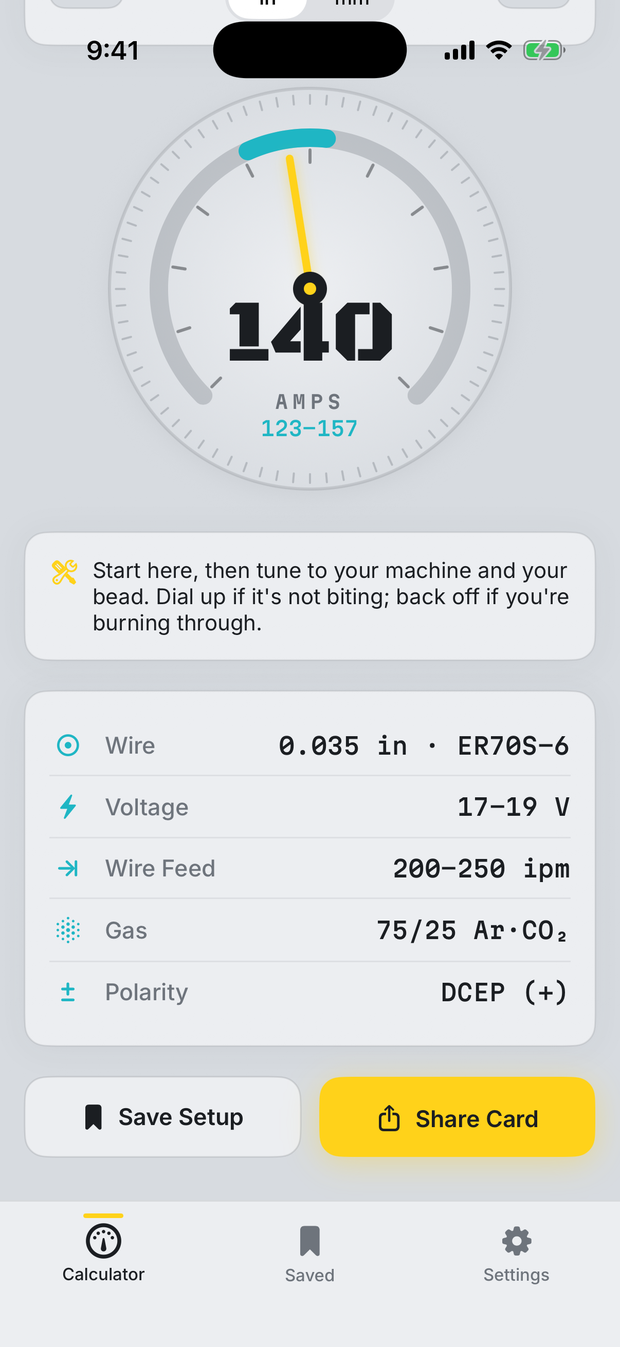
Showing 1/8 inch steel. Read any other thickness in the chart below.
Wire 0.035 in · ER70S-6 · Gas 75/25 Ar·CO₂ · Polarity DCEP (+) · Heat input ≈8.2 kJ/in
Start here, then tune to your machine and your bead. Dial up if it's not biting; back off if you're burning through.
The chart
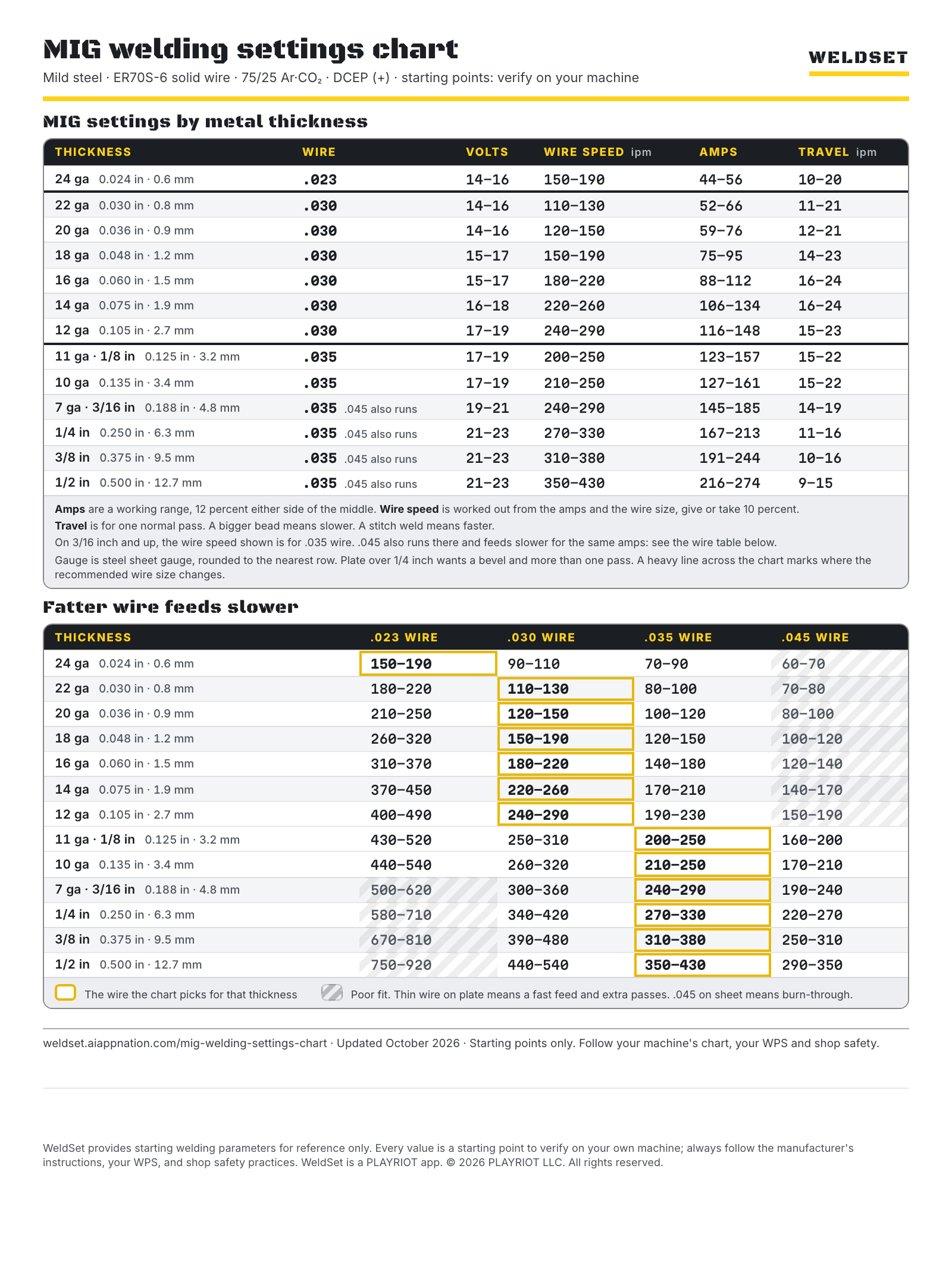
MIG settings by metal thickness
Mild steel, solid ER70S-6 wire, 75/25 argon/CO₂, DCEP. Each row uses the wire that suits the thickness. ipm means inches per minute.
Swipe sideways for every column →
| Thickness | Wire | Volts | Wire speedipm | Amps | Travelipm |
|---|---|---|---|---|---|
| 24 ga0.024 in · 0.6 mm | .023 | 14–16 | 150–190 | 44–56 | 10–20 |
| 22 ga0.030 in · 0.8 mm | .030 | 14–16 | 110–130 | 52–66 | 11–21 |
| 20 ga0.036 in · 0.9 mm | .030 | 14–16 | 120–150 | 59–76 | 12–21 |
| 18 ga0.048 in · 1.2 mm | .030 | 15–17 | 150–190 | 75–95 | 14–23 |
| 16 ga0.060 in · 1.5 mm | .030 | 15–17 | 180–220 | 88–112 | 16–24 |
| 14 ga0.075 in · 1.9 mm | .030 | 16–18 | 220–260 | 106–134 | 16–24 |
| 12 ga0.105 in · 2.7 mm | .030 | 17–19 | 240–290 | 116–148 | 15–23 |
| 11 ga · 1/8 in0.125 in · 3.2 mm | .035 | 17–19 | 200–250 | 123–157 | 15–22 |
| 10 ga0.135 in · 3.4 mm | .035 | 17–19 | 210–250 | 127–161 | 15–22 |
| 7 ga · 3/16 in0.188 in · 4.8 mm | .035.045 also runs | 19–21 | 240–290 | 145–185 | 14–19 |
| 1/4 in0.250 in · 6.3 mm | .035.045 also runs | 21–23 | 270–330 | 167–213 | 11–16 |
| 3/8 in0.375 in · 9.5 mm | .035.045 also runs | 21–23 | 310–380 | 191–244 | 10–16 |
| 1/2 in0.500 in · 12.7 mm | .035.045 also runs | 21–23 | 350–430 | 216–274 | 9–15 |
Amps are a working range, 12 percent either side of the middle. Wire speed is worked out from the amps and the wire size, give or take 10 percent.
Travel is for one normal pass. A bigger bead means slower. A stitch weld means faster.
On 3/16 inch and up, the wire speed shown is for .035 wire. .045 also runs there and feeds slower for the same amps: see the wire table below.
Gauge is steel sheet gauge, rounded to the nearest row. Plate over 1/4 inch wants a bevel and more than one pass. A heavy line across the chart marks where the recommended wire size changes.
Wire speed by wire size
Fatter wire feeds slower
Same amps, different spool: a fatter wire feeds slower. Find your wire size, then read down to your thickness. All numbers are wire speed in ipm.
Swipe sideways for every column →
| Thickness | .023 wire | .030 wire | .035 wire | .045 wire |
|---|---|---|---|---|
| 24 ga0.024 in · 0.6 mm | 150–190 | 90–110 | 70–90 | 60–70 (poor fit for this thickness) |
| 22 ga0.030 in · 0.8 mm | 180–220 | 110–130 | 80–100 | 70–80 (poor fit for this thickness) |
| 20 ga0.036 in · 0.9 mm | 210–250 | 120–150 | 100–120 | 80–100 (poor fit for this thickness) |
| 18 ga0.048 in · 1.2 mm | 260–320 | 150–190 | 120–150 | 100–120 (poor fit for this thickness) |
| 16 ga0.060 in · 1.5 mm | 310–370 | 180–220 | 140–180 | 120–140 (poor fit for this thickness) |
| 14 ga0.075 in · 1.9 mm | 370–450 | 220–260 | 170–210 | 140–170 (poor fit for this thickness) |
| 12 ga0.105 in · 2.7 mm | 400–490 | 240–290 | 190–230 | 150–190 (poor fit for this thickness) |
| 11 ga · 1/8 in0.125 in · 3.2 mm | 430–520 | 250–310 | 200–250 | 160–200 |
| 10 ga0.135 in · 3.4 mm | 440–540 | 260–320 | 210–250 | 170–210 |
| 7 ga · 3/16 in0.188 in · 4.8 mm | 500–620 (poor fit for this thickness) | 300–360 | 240–290 | 190–240 |
| 1/4 in0.250 in · 6.3 mm | 580–710 (poor fit for this thickness) | 340–420 | 270–330 | 220–270 |
| 3/8 in0.375 in · 9.5 mm | 670–810 (poor fit for this thickness) | 390–480 | 310–380 | 250–310 |
| 1/2 in0.500 in · 12.7 mm | 750–920 (poor fit for this thickness) | 440–540 | 350–430 | 290–350 |
Quick answers
MIG welding settings questions
What voltage and wire speed should I use to MIG weld 1/8 inch steel?
Start at 17–19 volts and 200–250 ipm wire speed with .035 wire. That lands around 123–157 amps. On .030 wire, feed about 250–310 ipm instead. These are starting points. Run a test bead and trim from there.
What amps do I need to MIG weld 1/4 inch steel?
About 167–213 amps at 21–23 volts, with .035 wire feeding at 270–330 ipm. A quarter inch is heavy for one pass. Bevel the joint, run more than one pass, and pre-heat if the shop is cold.
What gas flow rate should I use for MIG welding?
For mild steel with 75/25 argon/CO₂, Miller's mild steel guide says to set 20 to 25 CFH (cubic feet per hour). Miller gives 25 to 35 CFH for short-circuit MIG. Too little gas makes porous, pitted welds. Too much just wastes gas. Your machine manual and wire data sheet have the final number.
How do I set wire speed and voltage on a MIG welder?
Set the volts and wire speed from the chart. Run a test bead on scrap the same thickness. Listen for a steady sizzle, like bacon in a pan.
Wire stubs into the plate and pushes the gun back? Add voltage or slow the wire. Long, spitty arc with the wire balling up? Lower the voltage or speed the wire up. Change one thing at a time.
What polarity does MIG welding use?
Solid wire with shielding gas runs DC electrode positive (DCEP), also called reverse polarity (Miller). Gasless flux-core wire usually runs the other way, electrode negative (DCEN). Check the label on your wire.
How fast should I travel when MIG welding?
About 10–20 ipm on 24 gauge sheet and 14–19 ipm on 3/16 inch plate. Both match the figures Hobart Brothers publishes. The Travel column has every thickness. A bigger bead means slower. A stitch weld means faster.
Will this chart work on my welder?
It works as a starting point on any MIG welder. Machines differ, and published charts disagree with each other by 20 to 30 percent. The chart inside your wire-feed door wins. If your wire-speed dial has no units, use that door chart to see which number matches ipm on your machine.
What about stainless, aluminum or flux-core?
They need different wire, gas and numbers, so this chart does not cover them. The WeldSet app does: MIG on stainless and aluminum, flux-core, TIG and stick. MIG on mild steel is free in the app. The rest is one optional unlock.
weldset.aiappnation.com/mig-welding-settings-chart · Updated October 2026 · Starting points only. Follow your machine's chart, your WPS and shop safety.